Book Appointment Now

Gyno (Gynecomastia) Surgery in Peshawar
Quick answer: Gynecomastia (gyno) is enlargement of the male chest caused by extra gland tissue, extra fat, or both. At Transform Plastic Surgery Clinic on University Road, Peshawar, Dr. Waqas Hayat (MBBS, FCPS Plastic Surgery, PMDC 18790-N) first examines the chest to tell fat from gland. Fat is treated with liposuction; firm gland behind the nipple is removed through a small cut at the edge of the areola; many men need both. Most suitable cases are done as day surgery, often under local anaesthesia, and patients go home the same day. A compression garment is worn for several weeks, desk work usually resumes within a few days, and gym or heavy lifting waits for the surgeon’s clearance. Surgery starts from PKR 85,000 and usually costs PKR 85,000–120,000, depending on the amount of gland, fat and loose skin; the consultation fee is PKR 1,500. Exercise alone does not remove gland tissue.
Gynecomastia surgery at Transform Plastic Surgery Clinic, Peshawar, is performed by Dr. Waqas Hayat (MBBS, FCPS Plastic Surgery). The operation is chosen by tissue type: liposuction for fat-dominant chests, gland excision through a small incision at the edge of the areola for firm glandular tissue, or both combined. Many suitable cases are done under local anaesthesia as day surgery, and patients usually go home the same day. Fees start from PKR 85,000.
Gynecomastia Surgery: Key Facts
| Procedure | Liposuction, gland excision, or both; skin removal only for large or loose chests |
|---|---|
| Anaesthesia | Local anaesthesia in many suitable cases; general anaesthesia depending on extent and preference |
| Hospital stay | Day surgery; home the same day when medically appropriate |
| Compression garment | Usually advised; duration set individually according to the procedure and healing |
| Return to work | Office work is often possible earlier than physically demanding work; timing is advised individually |
| Gym and heavy lifting | Usually restricted for about 4 weeks |
| Scars | Small liposuction access points; an incision at the edge of the areola when gland is removed |
| Final result | Improvement is visible early; the chest continues to settle over the following weeks and months |
| Cost | From PKR 85,000; the final fee depends on grade, technique and anaesthesia. See gynecomastia surgery cost in Peshawar |
| Surgeon | Dr. Waqas Hayat, MBBS, FCPS (Plastic Surgery), 10 years’ experience · PMDC 18790-N |
| Consultation | Monday–Friday, 1:00–6:00 PM · 7B, 2nd Floor, Arbab Plaza, Phase 3 Chowk, University Road, Peshawar |
Medically reviewed by Dr. Waqas Hayat, MBBS, FCPS (Plastic Surgery) · Last updated
Further reading: Gynaecomastia (NHS) · Gynecomastia surgery (American Society of Plastic Surgeons)
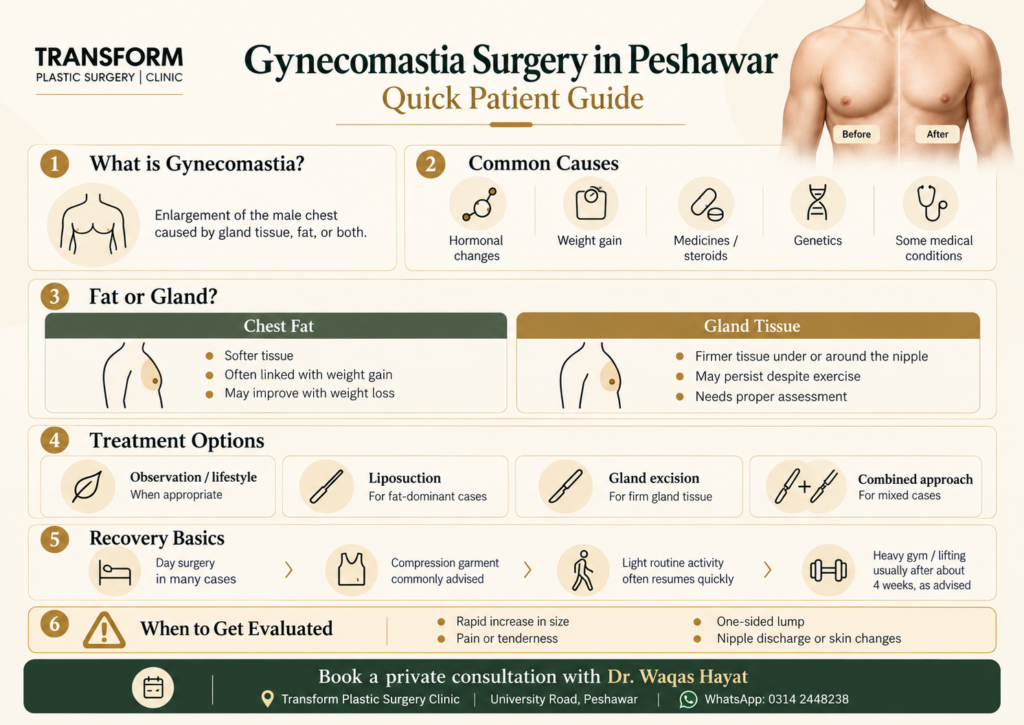
What Is Gynecomastia?
Gynecomastia is enlargement of male breast tissue caused by an increase in glandular tissue. It may affect one or both sides of the chest and can sometimes be associated with excess chest fat.
Some patients notice only mild fullness around the nipple, while others develop more obvious enlargement of the chest. Gynecomastia can also cause tenderness or sensitivity in some cases.
Gynecomastia is usually a benign condition. Treatment is not always necessary. However, assessment may be appropriate when the enlargement persists, causes discomfort or personal concern, or when there are unusual features that require further evaluation.
At Transform Plastic Surgery Clinic in Peshawar, Dr. Waqas Hayat assesses the chest, medical history and possible causes before recommending treatment. The aim is to determine whether the enlargement is caused predominantly by glandular tissue, fat, excess skin, or a combination of these factors.
Is It Gynecomastia or Chest Fat?
Gynecomastia and excess chest fat are not exactly the same condition.
True gynecomastia contains increased glandular breast tissue, which is often concentrated beneath or around the nipple and areola.
Pseudogynecomastia is enlargement caused predominantly by fatty tissue without significant glandular enlargement.
Many patients have a combination of both.
Weight loss and exercise can reduce excess body and chest fat, but established glandular tissue may remain even after weight reduction. A physical examination helps determine the type of chest enlargement and whether any treatment is required.
Why Does Gynecomastia Happen?
Gynecomastia can occur for several reasons. In some patients, no single cause is identified.
Hormonal Changes
Changes in the balance between testosterone and estrogen can stimulate breast tissue growth.
Gynecomastia is particularly common during puberty and can also occur later in adult life. Puberty-related gynecomastia often improves naturally as hormone levels stabilize, so immediate surgery is not always necessary.
Medicines and Other Substances
Certain prescription medicines, supplements and anabolic steroids can contribute to gynecomastia.
Patients should provide a complete list of medicines and supplements during consultation. Do not stop prescribed medication without discussing it with the doctor who prescribed it.
Medical Conditions
Gynecomastia can occasionally be associated with underlying conditions involving the liver, kidneys, thyroid, testes or hormone system.
Further investigations are not necessary for every patient. They may be advised when the medical history or examination suggests an underlying cause.
Weight and Chest Fat
Weight gain can increase fatty tissue in the chest and make existing gynecomastia more noticeable.
Weight reduction may improve a fatty chest, but it does not reliably remove established glandular tissue.
When Should Gynecomastia Be Evaluated?
A medical assessment is particularly important if you develop:
- Rapidly increasing breast enlargement
- Significant or persistent pain
- A hard or unusual lump
- Enlargement mainly affecting one side
- Nipple discharge or bleeding
- Changes in the skin or nipple
- A new breast swelling without an obvious explanation
These findings do not necessarily indicate a serious condition, but they should not simply be assumed to be routine gynecomastia.
Can Gynecomastia Go Away Without Surgery?
Yes, in some patients.
Treatment depends on the cause, age of the patient and duration of the condition.
Puberty-related gynecomastia often improves naturally with time. When a medicine or medical condition contributes to breast enlargement, addressing the underlying cause may also help.
Weight reduction can improve excess chest fat in overweight patients.
Persistent glandular gynecomastia, however, may not respond significantly to exercise or weight loss. Surgery can then be considered when the enlargement remains a concern and the patient is an appropriate candidate.
Gynecomastia Treatment Options
Treatment should be selected according to the type of tissue present rather than using the same operation for every patient.
Liposuction for Fat-Dominant Enlargement
Liposuction may be useful when excess fatty tissue forms a significant part of the chest enlargement.
Through small incisions, a cannula is used to reduce selected fatty tissue and improve the chest contour.
Liposuction removes fat but does not reliably remove firm glandular tissue beneath the nipple.
Gland Excision
When firm glandular tissue forms the main component of gynecomastia, surgical excision may be required.
The gland can usually be approached through an incision placed along part of the edge of the areola. The amount removed is determined according to the individual chest anatomy.
The objective is to reduce the gland while maintaining an appropriate contour beneath the nipple and across the chest.
Liposuction Combined With Gland Excision
Many patients have both excess fat and glandular tissue.
In these cases, liposuction and gland excision can be combined. Liposuction helps contour the surrounding chest while excision treats tissue that cannot adequately be removed with liposuction alone.
Treatment of Excess Skin
Patients with very large gynecomastia, significant skin laxity or major previous weight loss may also require treatment of excess skin.
This usually involves additional scars and therefore requires careful discussion before surgery.
How Gynecomastia Surgery Is Performed
The exact procedure is planned after examination.
At Transform Plastic Surgery Clinic, many suitable gynecomastia procedures can be performed under local anaesthesia. General anaesthesia may also be used depending on the extent of surgery, individual circumstances and patient preference.
The operation commonly includes:
- Preoperative marking of the chest
- Administration of appropriate anaesthesia
- Liposuction where required
- Removal of excess glandular tissue where required
- Careful assessment of chest contour and symmetry
- Closure of the incisions
- Application of dressings and compression
The procedure is commonly performed as day surgery. Patients remain under observation after surgery and can usually return home the same day when medically appropriate.
Is Gynecomastia Surgery Painful?
Appropriate anaesthesia is used during surgery to control procedural pain.
After surgery, patients commonly experience soreness, tightness, swelling or tenderness rather than severe pain. Long-acting local anaesthetic may also be used to improve comfort during the early postoperative period.
Oral pain medication is prescribed when required.
The amount of discomfort varies between patients and according to the extent of surgery.
Recovery After Gynecomastia Surgery
Recovery varies according to whether liposuction, gland excision or a combination of procedures has been performed.
First Few Days
Swelling, bruising, chest tightness and mild soreness are expected. Patients are encouraged to follow their postoperative instructions and attend scheduled follow-up appointments.
Returning to Routine Activities
Many patients undergoing uncomplicated surgery can return to light routine activities relatively quickly, according to their comfort and the nature of their work.
Office-based activity may be possible earlier than physically demanding work.
Compression Garment
A compression garment is usually advised after surgery. It supports the treated tissues and helps control postoperative swelling.
The duration of compression is individualized according to the procedure and healing.
Exercise and Heavy Lifting
Walking and normal light activity are encouraged as appropriate.
Heavy lifting, strenuous upper-body exercise and gym activity are generally restricted for approximately four weeks, or until adequate healing has occurred and the surgeon advises that these activities can be resumed.
Final Result
An improvement in chest contour can usually be appreciated early, but postoperative swelling initially affects the appearance.
The chest continues to settle over the following weeks and months. Final healing varies between patients.
Scars After Gynecomastia Surgery
All surgical procedures involving an incision produce a scar.
For gland excision, the incision is commonly placed along part of the border of the areola where possible. Liposuction requires small access incisions.
Scars are usually more noticeable during the early healing period and tend to mature with time. Their final appearance varies according to skin type, genetics, wound healing and the procedure performed.
A completely invisible scar cannot be guaranteed.
Expected Results and Limitations
Gynecomastia surgery aims to reduce excess breast tissue and create a flatter, better-proportioned chest contour.
The degree of improvement varies according to:
- Amount of glandular tissue
- Amount of fat
- Skin elasticity
- Degree of skin excess
- Chest asymmetry
- Healing characteristics
- Weight changes after surgery
Perfect symmetry cannot be guaranteed because natural differences between the two sides of the chest are common.
Patients with significant skin laxity may also continue to have some looseness unless skin-removal surgery is performed.
Can Gynecomastia Return After Surgery?
Removal of glandular tissue usually produces a long-lasting reduction in chest enlargement.
However, future changes can occur.
Significant weight gain, anabolic steroid use, certain medicines, hormonal disorders or other underlying causes may contribute to recurrent chest enlargement.
Maintaining a stable weight and addressing relevant underlying factors can help maintain the surgical result.
Risks and Possible Complications
Gynecomastia surgery is generally well tolerated in appropriately selected patients, but no operation is completely free of risk.
Possible complications include:
- Bleeding or hematoma
- Seroma or fluid collection
- Infection
- Delayed wound healing
- Visible or unfavourable scars
- Temporary or permanent changes in nipple sensation
- Chest or nipple asymmetry
- Contour irregularity
- Under-correction or over-correction
- Skin or tissue healing problems
- Persistent pain
- Anaesthesia-related complications
- Need for additional or revision surgery
Individual risks depend on the patient, medical history and extent of surgery and are discussed during consultation before informed consent.
Who May Be Suitable for Gynecomastia Surgery?
Surgery may be considered in men with stable, persistent gynecomastia who remain concerned by the enlargement after appropriate assessment.
Suitable patients generally:
- Are in good overall health
- Have stable breast development
- Have realistic expectations
- Understand the procedure and recovery
- Are willing to follow postoperative instructions
- Have addressed relevant underlying causes where possible
- Do not have medical conditions that make elective surgery unsafe
Surgery should not be undertaken simply because chest enlargement is present. The decision should follow an appropriate assessment and discussion of the available options.
Gynecomastia Surgery Cost in Peshawar
The cost of gynecomastia surgery in Peshawar depends on the type and extent of treatment required.
Factors affecting cost include:
- Liposuction alone versus gland excision
- Combination of liposuction and gland removal
- Amount of tissue involved
- Need for treatment of excess skin
- Type of anaesthesia
- Complexity of the procedure
- Individual clinical requirements
At Transform Plastic Surgery Clinic, gynecomastia surgery starts from PKR 85,000 (October 2026). The fee rises with the grade, the technique and the type of anaesthesia; see the gynecomastia surgery cost guide for what affects it.
A final quotation should be provided after examination because different patients require different procedures.
Why Choose Transform Plastic Surgery Clinic?
Transform Plastic Surgery Clinic provides plastic and reconstructive surgical care in Peshawar with an emphasis on appropriate patient selection, clear communication and individualized treatment planning.
Assessment by an FCPS-Qualified Plastic Surgeon
Dr. Waqas Hayat, MBBS, FCPS (Plastic Surgery) assesses patients considering gynecomastia treatment and plans surgery according to the type of chest enlargement and individual anatomy.
Learn more about Dr. Waqas Hayat.
Individualized Surgical Planning
Gynecomastia is not the same in every patient.
The treatment plan may involve liposuction, gland excision, both procedures, or—where appropriate—no immediate surgery.
Clear Discussion of Expectations
Before proceeding, patients are informed about:
- The proposed procedure
- Anaesthesia options
- Recovery
- Scarring
- Expected improvement
- Limitations
- Possible complications
- Cost
Follow-Up
Follow-up is provided throughout the postoperative recovery period.
Frequently Asked Questions About Gynecomastia
Can Gynecomastia Go Away With Exercise?
Exercise can reduce overall body fat and improve chest muscle definition. However, exercise does not reliably remove established glandular breast tissue.
Can Weight Loss Cure Gynecomastia?
Weight loss can significantly improve a fatty chest or pseudogynecomastia. True glandular gynecomastia may remain despite weight reduction.
Does Gynecomastia Go Away After Puberty?
Puberty-related gynecomastia frequently improves naturally as hormone levels stabilize. Persistent enlargement should be assessed if it remains a concern.
Which Doctor Treats Gynecomastia?
Initial evaluation may involve a general physician or relevant specialist depending on the suspected cause. Persistent gynecomastia requiring surgical treatment is commonly managed by a qualified plastic surgeon.
Is Gynecomastia Dangerous?
Gynecomastia itself is usually benign. However, unusual findings such as a hard lump, nipple discharge, skin changes or rapidly increasing one-sided enlargement should be medically assessed.
Is Gynecomastia Surgery Permanent?
Surgical reduction can provide a long-lasting result, but recurrence or new enlargement can occur with significant weight gain, medicines, anabolic steroids, hormonal disorders or other contributing factors.
Is Gynecomastia Surgery Done Under Local Anaesthesia?
Many suitable cases can be performed under local anaesthesia. General anaesthesia may be appropriate depending on the extent of surgery and individual circumstances.
Can I Go Home the Same Day?
Most uncomplicated gynecomastia procedures at our clinic are managed as day surgery, with discharge after an appropriate period of postoperative observation.
Book a Gynecomastia Consultation in Peshawar
If you are concerned about chest enlargement, a clinical assessment can help determine whether you have glandular gynecomastia, excess chest fat, or a combination of both.
During your consultation with Dr. Waqas Hayat, we will:
- Assess the chest and tissue distribution
- Review relevant medical history and medications
- Determine whether further investigation is necessary
- Discuss whether treatment is required
- Explain liposuction, gland excision and other appropriate options
- Discuss anaesthesia and recovery
- Explain expected improvement and limitations
- Discuss possible risks
- Provide an individualized treatment plan and cost estimate
If you would like to know whether gynecomastia treatment is appropriate for you, book a gyno consultation.
Transform Plastic Surgery Clinic
Office 7B, Arbab Plaza, University Road, Peshawar
Dr. Waqas Hayat
MBBS, FCPS (Plastic Surgery)
Consultant Plastic Surgeon
Consultation Hours: Monday–Friday, 1:00 PM–6:00 PM
Consultation Fee: PKR 1,500
Website: transformplasticsurgeryclinic.com
Medically Reviewed By
Dr. Waqas Hayat
MBBS, FCPS (Plastic Surgery)
Consultant Plastic Surgeon
Transform Plastic Surgery Clinic, Peshawar
Last reviewed: October 2026
FAQ
Is gynecomastia surgery safe?
Yes, gynecomastia surgery is routinely performed and considered very safe when done by a qualified plastic surgeon. It is even safer under local anesthesia with sedation, and most patients return home the same day.
Is gynecomastia surgery painful?
During general anesthesia, you won’t feel any pain. We also use local anesthesia for added comfort. Mild soreness may occur after the first day, but oral painkillers ensure a smooth, pain-free recovery.
Is gynecomastia itself painful?
Gynecomastia usually isn’t painful. However, if you experience tenderness or discomfort, it’s best to consult a specialist to rule out other conditions.
Can gynecomastia go away without surgery?
In most cases, surgery is the most effective treatment for gynecomastia, especially when it’s not caused by an underlying medical condition. Hormonal imbalances may require medical treatment, but tissue won’t shrink on its own.
Will exercise reduce gynecomastia?
Exercise can improve overall fitness and chest tone, but it does not target glandular tissue. If you’re dealing with true gynecomastia, surgery is the most reliable option.
Can gynecomastia turn into cancer?
No, gynecomastia is not linked to breast cancer. It’s a benign condition and does not increase cancer risk.
How does gynecomastia look?
Gynecomastia may present as:
- Puffy or swollen chest tissue
- A lump under the nipple
- Enlarged breasts (one or both sides)
- Mild tenderness or sensitivity
How long is recovery after gynecomastia surgery?
Most patients return to work within 3–5 days and resume full activities after 2–3 weeks. Swelling continues to subside over a few months.
Will there be visible scars?
Scars are small and placed where they are less visible. Most incisions are made around the areola or in the chest fold, and they fade significantly over time.
Is the result permanent?
Yes, once the excess tissue is removed, the results are long-lasting—especially with a stable weight and healthy lifestyle.
Consultation
Other Services
- Gynecomastia treatment
- Rhinoplasty
- Hair Transplant
- Tummy tuck (Abdominoplasty)
- Blepharoplasty
- Liposuction
- Non- Surgical Facial Rejuvenation
Please review our Privacy Policy and Terms of Service before booking consultation or treatment at the clinic.
Written and medically reviewed by
Dr. Waqas Hayat, MBBS, FCPS (Plastic Surgery) · PMDC 18790-N
Plastic and reconstructive surgeon in Peshawar with 10 years of experience. Member of the Pakistan Association of Plastic Surgeons and Managing Editor of the Journal of Postgraduate Medical Institute (JPMI). Author of 15 peer-reviewed papers and 2 book chapters.
Meet the surgeon · Editorial policy · Research · Book a consultation