Book Appointment Now

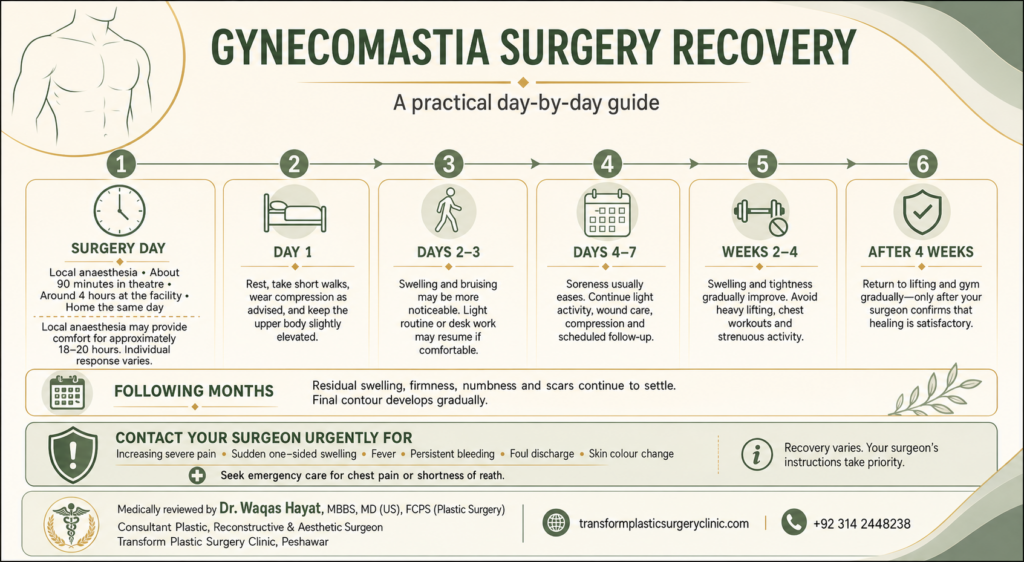
Gynecomastia Surgery Recovery Timeline: Day-by-Day Guide
Recovery after gynecomastia surgery is gradual. Most patients can walk, eat and return home on the day of surgery. Light routine activities may be possible the following day, but swelling, internal healing and activity restrictions continue for several weeks.
At Transform Plastic Surgery Clinic in Peshawar, most gynecomastia procedures are performed under local anaesthesia as day-care surgery. The operation usually takes approximately 90 minutes, and patients typically spend around four hours at the facility, including preparation, surgery, observation and discharge.
This timeline explains what patients may experience from the first day through the following months. It is a general guide: your individual operation, health, healing response and surgeon’s instructions take priority.
Gynecomastia Recovery at a Glance
Anaesthesia: Usually local anaesthesia at our clinic
Operating time: Approximately 90 minutes
Time at the facility: Approximately four hours
Hospital stay: Usually discharged home the same day
Eating: Generally permitted with local anaesthesia without sedation, according to clinic instructions
Light routine activities: Often possible the following day
Desk-based work: May be possible within one to several days
Heavy lifting and chest training: Avoid for at least four weeks
Gym: Resume gradually after surgical clearance
Visible swelling: Improves progressively over several weeks
Final contour: Develops over several months
Published recovery estimates differ because gynecomastia surgery can range from limited gland removal to more extensive liposuction, skin removal and nipple repositioning. Both the NHS and Cleveland Clinic emphasize that soreness, swelling and activity restrictions continue beyond the first few days.
What Happens on the Day of Surgery?
Anaesthesia
Most gynecomastia procedures at Transform Plastic Surgery Clinic are performed under local anaesthesia. The patient remains awake, while the chest is thoroughly numbed.
You may notice pressure, pulling or movement during surgery, but you should not experience sharp surgical pain. If you feel discomfort, inform the surgical team so the anaesthesia can be assessed and supplemented when appropriate.
General anaesthesia is available when a patient prefers to remain asleep, provided it is medically suitable after the required assessment. Patients receiving general anaesthesia—or sedation where applicable—must follow the fasting and discharge instructions provided by the anaesthesia team.
Operation and observation
The operation usually takes about 90 minutes, although more extensive surgery can take longer. The complete stay at the facility is approximately four hours and includes:
Preoperative preparation and markings
Administration of anaesthesia
Liposuction, gland excision or both
Dressings and compression-garment application
Postoperative observation
Assessment before discharge
Gynecomastia surgery is generally performed as a day-care procedure at our clinic, allowing most patients to return home the same day.
Eating and drinking
Patients having local anaesthesia without sedation generally do not require the same fasting protocol used for general anaesthesia. They can eat according to the clinic’s instructions before and after surgery.
Do not assume that fasting is unnecessary in every case. Follow the specific instructions given to you because sedation, general anaesthesia or certain medical conditions may change the requirements.
Pain immediately after surgery
Our local-anaesthesia protocol may continue providing pain relief for approximately 18–20 hours, although the duration varies between patients.
The chest may initially feel numb, tight or heavy. Soreness can become more noticeable as the anaesthetic wears off. Take prescribed pain medication according to the schedule provided rather than waiting until discomfort becomes severe.
Day 1: Rest, Walk and Protect the Chest
During the first day:
Rest at home
Take short, gentle walks
Wear the compression garment as instructed
Keep the upper body slightly elevated while resting if advised
Take prescribed medicines exactly as directed
Keep dressings clean and dry
Avoid lifting, pushing and pulling
Walking is encouraged because complete bed rest is unnecessary and may increase stiffness. However, walking around the house is different from exercise.
Some tightness, swelling, tenderness or altered nipple sensation is expected. Your chest will not yet represent the final result.
Days 2–3: Swelling and Bruising May Become More Noticeable
Swelling and bruising may be more apparent during the first few days. One side may temporarily appear more swollen than the other, but sudden or rapidly increasing one-sided swelling requires medical assessment.
You may feel:
Soreness similar to a demanding chest workout
Tightness when moving the arms
Pressure from swelling
Temporary numbness or sensitivity
Mild discomfort when getting out of bed or changing clothes
Many patients can resume light personal activities or desk-based work if comfortable. However, physically demanding work, lifting, repetitive arm movement and gym activity remain restricted.
Showering depends on the dressings, incision closure and your surgeon’s protocol. Do not remove dressings or expose the incisions to water unless you have been told it is safe.
Days 4–7: Early Discomfort Usually Begins to Ease
By the end of the first week, soreness should generally be improving rather than worsening.
Patients can usually continue:
Walking
Desk-based work
Light household activity
Gentle arm movement within a comfortable range
Continue to avoid:
Heavy lifting
Chest exercises
Running or strenuous cardio
Forceful pushing or pulling
Activities that place pressure on the chest
A follow-up examination may be arranged to assess swelling, dressings and wound healing. Drains are used selectively rather than routinely; if placed, their removal depends on the amount and nature of the drainage—not an identical day for every patient.
The American Society of Plastic Surgeons notes that compression garments, drains and postoperative instructions should be individualized according to the procedure and patient.
Week 2: Returning to Routine Activities
During the second week, bruising and swelling commonly begin to settle, although neither must disappear completely.
You may notice:
Firm areas beneath the skin
Temporary numbness
Tingling or intermittent sensitivity
Mild asymmetry caused by swelling
Itching around healing incisions
These changes can occur during normal healing, but they should be discussed during follow-up rather than diagnosed from an online description.
Patients with desk-based occupations are generally back at work by this stage. Jobs involving lifting, manual work, driving for long periods or repeated upper-body movement require an individualized return-to-work plan.
Wear the compression garment for the period prescribed by your surgeon. It should feel supportive without causing breathing difficulty, severe pain, deep pressure marks or skin-colour changes.
Weeks 3–4: Internal Healing Continues
By the third and fourth weeks, many patients feel substantially better and may underestimate how much internal healing is still occurring.
Light cardiovascular activity may be introduced only when permitted. Walking can usually be increased gradually, but chest training and heavy resistance exercises remain restricted.
At Transform Plastic Surgery Clinic, patients are advised to avoid heavy lifting for at least four weeks. This includes:
Weight training
Push-ups and bench presses
Heavy luggage
Forceful pushing or pulling
Physically demanding work
Activities that significantly strain the chest
Premature strenuous activity can increase swelling and may contribute to bleeding, fluid accumulation or wound problems.
After Four Weeks: Gradual Return to Exercise
Four weeks is a review point—not an automatic declaration that every patient is fully healed.
If wound healing and chest examination are satisfactory, your surgeon may allow a gradual return to exercise. Begin below your previous intensity and increase progressively.
Chest exercises, heavy lifting and contact sports may require additional delay, particularly after extensive gland removal, skin excision, nipple repositioning or a postoperative complication.
Stop exercising and contact the clinic if activity causes:
Increasing pain
New or worsening swelling
Bleeding or wound discharge
A sudden change in chest shape
Wound separation
General published recommendations vary. The NHS advises avoiding strenuous exercise and heavy lifting for several weeks, while Cleveland Clinic advises avoiding heavy lifting and overhead reaching during healing. Your operation-specific instructions are therefore more important than a universal online date.
Following Months: Swelling, Sensation and Scars Continue to Change
The chest contour develops gradually as swelling settles and the tissues soften.
During the following months:
Residual swelling decreases
Firm areas may soften
Chest definition becomes clearer
Nipple sensation may change or gradually recover
Scars mature and usually become less conspicuous
Minor early asymmetries may improve as swelling resolves
Cleveland Clinic states that results may take approximately three to six months to become apparent. The NHS similarly notes that the full result may take up to six months. Scars can continue maturing beyond this period.
Temporary numbness is common, but full sensation cannot be guaranteed. Some sensory change may persist.
How Long Should the Compression Garment Be Worn?
A compression garment supports the operated tissues and helps control swelling. However, there is no evidence-based duration that is identical for every patient and technique.
The correct duration depends on:
The amount of liposuction
The amount of gland removed
Skin elasticity
Swelling
Whether skin was removed
Wound condition
The surgeon’s operative protocol
Wear the garment as prescribed. Do not tighten it excessively in an attempt to obtain a faster or flatter result.
Contact the clinic if the garment causes severe pain, breathing difficulty, skin discoloration, blistering, numbness that is getting worse or deep pressure marks.
How Should You Sleep?
Patients are commonly advised to sleep on their back during early recovery to avoid direct pressure on the chest. Slight upper-body elevation may improve comfort and make getting out of bed easier.
Return to side or stomach sleeping only when it is comfortable and your surgeon considers it appropriate.
When Can You Drive?
Do not drive if:
You received sedation or general anaesthesia and remain within the restricted period
You are taking medication that causes drowsiness
Arm movement is restricted
Sudden steering or emergency braking would be painful
A seatbelt causes significant discomfort
Your surgeon has not cleared you
The NHS recommends waiting until wearing a seatbelt and controlling the vehicle are no longer painful.
Wound and Scar Care
Follow the wound-care instructions provided at discharge. General precautions include:
Keep the incisions and dressings clean
Do not apply unapproved creams, oils or antiseptics
Do not scratch or rub healing incisions
Do not remove scabs or adhesive strips prematurely
Avoid swimming until the wounds are completely healed and permission is given
Protect established scars from strong sunlight
Silicone gel or silicone sheets may be considered after the wound has fully closed, but they should not be placed over an open or infected incision. Scar massage should begin only when approved.
Smoking, Nicotine and Recovery
Smoking, vaping and other nicotine products can restrict blood flow and interfere with wound healing. They may increase the risk of infection, wound separation, poor scarring and skin or nipple–areola circulation problems.
Follow the surgeon’s instructions regarding nicotine cessation before and after surgery. Concealing tobacco, nicotine, steroid or medicine use can place your safety at risk.
Which Symptoms Require Urgent Assessment?
Contact your surgeon promptly if you develop:
Severe pain that is not controlled by prescribed medication
Pain that is increasing instead of improving
Sudden or rapidly increasing one-sided swelling
A tense or markedly uneven chest
Persistent bleeding
Fever or chills
Increasing redness or warmth
Pus or foul-smelling discharge
Wound separation
Darkening, blistering or unusual colour change of the nipple or skin
Bleeding beneath the skin—a haematoma—often presents with increasing pain, tension and swelling, frequently affecting one side more than the other. It requires urgent examination.
Seek emergency medical care for:
Chest pain
Shortness of breath
Fainting
A rapid or irregular heartbeat
Any severe or rapidly worsening symptom
ASPS and Cleveland Clinic both advise immediate medical assessment for chest pain or breathing difficulty following gynecomastia surgery.
Frequently Asked Questions
Can I go home on the day of surgery?
Usually, yes. Most gynecomastia operations at Transform Plastic Surgery Clinic are performed under local anaesthesia as day-care procedures. Discharge depends on your postoperative assessment and general condition.
Can I eat after surgery?
Patients undergoing local anaesthesia without sedation can generally eat according to clinic instructions. Fasting rules are different when general anaesthesia or sedation is used.
Can I return to work the following day?
Light desk-based work may be possible the next day if you feel comfortable. This does not apply to physically demanding occupations, driving-intensive work or jobs requiring lifting and repeated arm movement.
Is gynecomastia recovery painful?
Soreness, tightness and tenderness are expected, particularly as the local anaesthetic wears off. Severe or progressively increasing pain is not routine and should be reported.
When can I lift heavy objects?
Avoid heavy lifting for at least four weeks. Resume gradually only after your surgeon confirms that healing is satisfactory.
When can I restart the gym?
Gym activity should be reintroduced gradually after surgical clearance. Chest training and heavy weights are generally among the last activities resumed.
When will I see the final result?
Early improvement becomes visible as swelling decreases, but the contour continues changing for several months. Final timing varies with the surgical technique, swelling and individual healing.
Are the results permanent?
Removed glandular tissue does not usually return. However, significant weight gain, anabolic steroid use, hormonal changes, certain medicines or an untreated underlying cause may change the chest again.
Final Takeaway
Most gynecomastia procedures at Transform Plastic Surgery Clinic are performed under local anaesthesia and take approximately 90 minutes. Patients usually spend around four hours at the facility and return home the same day.
Light routine activity may be possible the following day, but this should not be mistaken for complete healing. Swelling, firmness and internal tissue recovery continue for several weeks. Heavy lifting and chest training should be avoided for at least four weeks and resumed gradually only after surgical assessment.
The safest recovery is guided by the operation actually performed, your physical examination and your surgeon’s instructions—not by a fixed internet timeline.
Learn more about gynecomastia surgery in Peshawar or book a consultation for an individualized assessment.
Written and medically reviewed by:
Dr. Waqas Hayat, MBBS, FCPS (Plastic Surgery)
Consultant Plastic, Reconstructive and Aesthetic Surgeon
Transform Plastic Surgery Clinic, Peshawar
Last updated: 26 July 2026
This article provides general patient education and does not replace an examination, diagnosis or individualized postoperative advice. Recovery varies according to the procedure and patient.
Medical References
American Society of Plastic Surgeons. Gynecomastia Surgery Recovery.
Cleveland Clinic. Gynecomastia Surgery: Procedure, Recovery and Risks.
National Health Service. Male Breast Reduction.
Services
- Gynecomastia treatment
- Rhinoplasty
- Hair Transplant
- Tummy tuck (Abdominoplasty)
- Blepharoplasty
- Non- Surgical Facial Rejuvenation
Please review our Privacy Policy and Terms of Service before booking consultation or treatment at the clinic.
Written and medically reviewed by
Dr. Waqas Hayat, MBBS, FCPS (Plastic Surgery) · PMDC 18790-N
Plastic and reconstructive surgeon in Peshawar with 10 years of experience. Member of the Pakistan Association of Plastic Surgeons and Managing Editor of the Journal of Postgraduate Medical Institute (JPMI). Author of 15 peer-reviewed papers and 2 book chapters.
Meet the surgeon · Editorial policy · Research · Book a consultation